Author Archives: Ohad

Power doesn’t corrupt.

People say that power corrupts and I take issue with the simplification. “Power” (i.e. the ability to influence another’s life, in this instance) in itself doesn’t corrupt, but the realities that come with it sometimes do. Influence distances you from others (this is often worded as “it’s lonely at the top”), the distance creates alienation, and if you’re not careful, it erodes empathy. That’s the danger zone.

We’re sold on the role of the leader or power broker and how amazing it is to be in control. I love being CEO but there are elements of the job that are grating and problematic and must be managed. One of the most problematic elements is people management at scale. Early teams may be bound by personal relationships and a shared sense of mission but scaling cannot (and shouldn’t) create a homogenous team. By your 100th employee you have a decent chance of hiring someone who grows to dislike you, someone who’s a “coaster”, maybe a psychopath. You’ll hire a bunch of people who have different motivations, are in a different spot in their career, or are just different than you. You’ll need to fire people. You’ll face criticism that may feel deeply unfair. You’ll also hire amazing people that will do incredible things but for type-A people who become CEOs it’s the criticism that registers the most.

All in all pretty stressful if you can’t handle it.

Some try to deal by referring to their team as a “family”. That’s deeply wrong because the word “family” implies a level of commitment that doesn’t exist in companies. You don’t fire a family member and they don’t leave you. You don’t negotiate base pay with your uncle. Thinking of your team as a family creates unreasonable expectations that are bound to disappoint.

The more common way is to be jaded, feel betrayed, decide that employees “just don’t get it.” That’s the alienation that leads to eroded empathy. Thinking of people like chess pieces. It’s arguably a natural response based on research telling us that our frame of human reference can hardly encompass more than 50 people, but it’s also the wrong sentiment and must be resisted vigorously.

We have to hold on to empathy. You can partly manage this issue by thinking of your public self as a separate persona (I sometimes do) but at the end of the day you must accept that having influence over others opens you up to be influenced by them. It’s a two way street. My old martial arts Sensei used to say that people think of strength as not being dependent on anyone, but “We weaken ourselves by accepting our dependency on others and their dependency on us. That is true power.” I like this sentiment. Holding on to empathy is crucial. It’s also easier when you take care of yourself and have a support network that keeps you grounded.

The 50% rule

Talking to first time CEOs and executives in high growth companies, the thing that overwhelms them the most is the nagging feeling that they have to actively operate the business or everything falls apart. This often leads to exhaustion, mental first and then physical, which in turn hurts their ability to do their actual job.

Like most other things, I had to learn this the hard way and was forced to hire lieutenants during my first stint as a senior manager. Steve Jobs was once quoted that about 50% of his time is unstructured (can’t find the quote now). I think that’s roughly true. Spending time away from tactical responsibilities allows you to:

  1. Think strategically. One CEO told me how the first time he took a vacation after 4 years in the trenches led to deeper thinking and an acquisition by a public company. Worrying about tactical issues drains that capacity for strategic thought.
  2. Fix major issues. As a senior exec you’re going to get involved to steady the ship, right a wrong, save a major relationship. This is especially common in enterprise startups where you’re often fodder for the client’s senior execs to chew on to protect your team. This is both stressful and humbling and cannot be done if you’re exhausted.
  3. Convince. Once you reach a certain size it’s not about just fight or flight anymore. You have a large team of opinionated people and you need to inspire, convince, and direct them instead of practicing battlefield command and control.

The amount of time I spend thinking, talking, and writing about the business rather than creating anything will surprise anyone and stands in complete contrast to the “creator” myth that startupland loves so much. As a growth CEO it’s my job to become an ideas merchant, not a builder. Staying at the right level of abstraction and leaving a lot of unstructured time is critical.

Why work for a Series B startup

Between large companies paying insane salaries to the cost of starting a company plummeting in the past decade, why work for a Series B company? They’re often messy, equity’s not as good as an early stage company, career ladder not as well defined as a largeco.

Series B companies are spring boards. If you are a top performer frustrated by corporate politics or a rigid career ladder, you’ll get much more responsibility faster in a series B company. Unlike in early stage startups, it will be better defined for a specific practice, so you can be a lawyer or client success manager and get promoted quickly rather than have to be “person who fixes production issues at 2am”.

Series B companies offer more visibility. At this stage organic growth usually isn’t enough so if you’re articulate or a good writer you could find yourself speaking publicly more often than you would otherwise.

Companies at this stage are also on the cusp of meaningful specialization. You can get an opportunity to own your niche area, define and grow it, be it UX or content marketing or software architecture.

I used to be part of the cult of entrepreneurship and thought that everyone should start a company. That’s silly. There are many more opportunities for scale and growth post Series A or B. While you “pay” for the reduced risk with a smaller equity windfall, most early stage startups fail anyway. If you’re an up and coming professional looking to grow fast, growth stage is the perfect time to join a startup.

Motivation

Many words spilled this week about founders’ motivation to start companies, mostly by people who aren’t founders.

I start companies because I want to control my destiny. The corporate world is as insane as feudal Europe sometimes, and some of us don’t want to be someone’s court jester or kiss a brass ring. I don’t know if it’s a noble motivation but I do know that I’d rather achieve that level of independence alongside team members I appreciate and who enjoy that same sensation (co-founders and employees) and that if you’re lucky, like I am with TrueAccord, it aligns with a business that actually makes a social difference and will be huge.

Given the above, it’s clear that exit calculations at Seed or D make little sense because an exit is never the goal. I don’t think of companies as solely a mechanism for transfer of wealth. Naturally, it’s easier for me to write this after I’ve had an exit.

It’s also clear that the title “serial entrepreneur” is as silly as “serially failing to achieve independence”. You don’t get married hoping to get divorced in two years, or at least I hope you don’t. You get married for the happily ever after.

Company founding also isn’t, for me, about being right once and going the angel investor to VC route. My company isn’t a pet project to show that I can qualify for the next level in the distributed corporate world that a part of Silicon Valley has become.

There’s nothing wrong with the above approaches. They’re just not my thing. I respect other people and their choices and frankly, many of them are smarter than starting and scaling a company because they are less painful. I’m the one who’ll be chugging away ten years from now, running a three thousands person company worth a significant amount, fighting unhealthy routines and putting out ever larger fires and whatever else you need to do at that scale (hopefully not playing golf. I dislike golf). That’s just my thing.

4th of July

A note I sent to the TrueAccord team today:

Happy 4th of July, everyone.

If you’ll allow me my soapbox moment: for all the doom and gloom and concern many (but not all!) share, for all its complexities and faults, for *me personally* this is still the greatest nation on earth. The land of the free and the home of the brave, whether you’re born to it or adopt it. As a proud immigrant on this day of independence, I hope to celebrate my next independence day as a citizen. I am proud to be fixing this country with you, one underserved consumer at a time. Proud to be together in the modern trenches. Let’s keep on making magic together.

Have a great day!

About leaving

The rolling dunes of the Israeli desert shift all the time. Leave a footprint, and soon enough it disappears. The wind blows fine sand around and covers your tracks, until only the Bedouin rangers can track you down, if at all.

***

When I was twenty-nine years old, my boss at PayPal was let go. They didn’t say why. He was going to spend time with his family, corporate PR said. It wasn’t the truth.

I called my VP. I’m ready to take over the branch office, I said. She was polite, but nothing came of it. No one would say it to your face over there. She didn’t think I was ready. I thought I was. I was wrong, but I didn’t know that.

A few months later, they announced they hired someone. He’s Chief Risk Officer at PayPal now. On his first day, when I met him, I said – it’s not personal, I’m leaving Israel. I’m going to San Jose. Ok, he said, how soon can you leave?

W–what? I’m indispensable! I didn’t say that. I just knew it to be true.

When I left, I thought there would be much fanfare. I had just turned thirty. I told the story of how I started five years earlier. I choked up a bit. People were very nice. They clapped when I finished my talk. There were pretzels.

Within two months, the team reorganized without me. I left footprints, slowly covered by the sands of time. A sentence in a job description. A procedure file. Several hires. Eventually even the Bedouin couldn’t find me. I was gone.

Confused, I called my mentor, Davidi. I don’t understand this thing, I said. How come I vanished this way, so fast? It was five years of my life.

Davidi sighed. When are you going to take your head out of your ass and understand that it’s not about you? He was fifty-five years old and slowly dying of cancer. Gentle delivery wasn’t a priority.

I didn’t get it then.

***

In 2011 I was thirty-one years old. I was Chief Risk Officer at Klarna and had just parted ways with a senior manager from my team. I had to, for various reasons. I didn’t say he was going to spend more time with his family. He went to start a risk management team at another company, and within a short while he poached M.

I didn’t think much of M, I told the COO. It was the truth. Losing him was okay. I’ll be worried if he hired F.

The following week, F gave his notice.

The CEO came to my apartment. He was upset. He was on the phone with the COO, his co-founder. Niklas says you said you couldn’t afford to lose F, he said. I didn’t have an answer. That night was the first time I lost sleep. It wasn’t the last.

Within two months, the team reorganized without them. Some signs lingered. Lines of code. A document or two. A couple of hires. But people rose to the challenge. Some I promoted, some hired. Eventually all of the old team’s footprints were gone, covered by the sands of time. The organization got over them. 

***

I didn’t get it then but I get it now. People are important, but communities are stronger than the individuals that comprise them. Strong companies with strong momentum are especially resilient.

It’s not about you. It’s not about me. It’s about this construct we build and maintain, a company. It’s bigger than just us. It has a life of its own. You leave when your story ends, hopefully not too soon, and you leave a footprint, but the company lingers. It is stronger than any individual. People will rise to the challenge; they will grow into new roles. Some stories will diverge from ours and some will join in. And that’s how it’s supposed to be.

With great power comes… a great misunderstanding

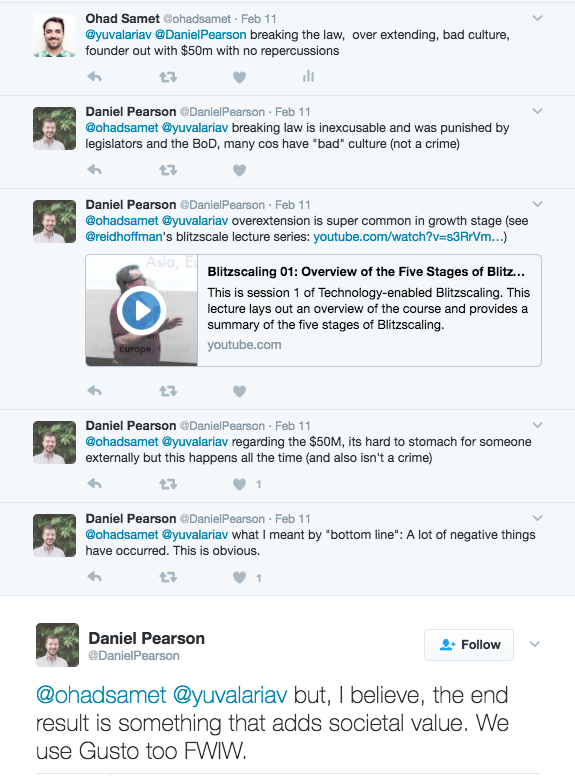
I don’t have the time to write an assay about the topic, but the growing disconnection between legality and morality in Silicon Valley is alarming. I’m going to just put this thing here so I’m on the record.

(Disclaimer: I don’t know Daniel Pearson and he may be the best guy on earth. I’m simply referring to the opinion he expresses here)

Screen Shot 2017-02-12 at 12.44.55 PM

Companies like Zenefits are a problem not only because they broke the law. That’s meaningful, but is not the only issue. They are meaningful because they enshrined abuse of power and misrepresentations as a way of doing business. They mixed inexperienced employees with power hungry inexperienced executives in a business that was growing too fast for its own good.

Zenefits is not alone, they are just the tip of the iceberg and they got caught because they also broke the law. The abuse of power is the much bigger issue. One, because it is prevalent. Two, because it is not often discussed. Three, because it is the result of people conflating financial success with moral superiority. The latter isn’t a new idea and was introduced by Max Weber in the start of the 20th century. The latest turn is using financial success to justify immoral behavior, and flaunting social norms because they aren’t the law. Yes, including with the elected President.

What’s abuse of power? It’s cashing out from your anonymous-abuse-enabling app that is only growing thanks to the abuse before it crashes and burns. It’s creating an excessive drinking culture in the workplace that may pressure inexperienced employees into acts they may not be interested in. It’s self dealing in office. It’s hiring managers who focus on rating employees by their looks. It’s founders buying back stock from employees at a discount because they know a valuation-popping event is coming up. All of these may not be illegal or provable in court. They’re still wrong. The fact that people (let’s face it – men) in SV express that they matter less because someone is rich or created business value is preposterous. Dollars are not the only way to measure value; they’re not even the most important way. We just lost our compass, as a subculture, because we got flush with too much money. It’s a sad realization.

Why I Can’t Get Behind John Oliver’s Latest Debt Collection Piece

We started TrueAccord in 2013 because we wanted to crowd out the “bad guys” in the debt collection space. Every dollar that will be paid through our system, we figured, is a dollar not paid through them. We will get involved in the messy world of debt collection, get our hands dirty, actually deal with those in debt instead of providing technology and hoping for the best. And we will emerge the winners.

Three years later, we still believe that. Those in debt who choose to work with us get flexible payment plans, where every dollar pays for their debt – principal first. Their interest is frozen. We don’t charge fees. More and more banks, issuers and large companies work with us, and they care so much about their customers’ experience that they push us to be even more lenient than we ever thought we could be.

Looks like we did it; we’re the good guys. And when John Oliver bashes debt collectors and debt buyers on his show, I should be thrilled. I should be one of those who stand on the sidelines and point and laugh and cheer at the tremendous feat of forgiving almost $15 million of old debt. But I don’t. I’m actually quite pissed.

Why is that? What’s in this piece that gets on my nerves?

Don’t get me wrong, I like the show. Who doesn’t like getting the news shouted at them with a British accent? I also get that he’s not a journalist, he’s an entertainer, and the video was indeed entertaining. It had another problem, though: it absolutely, completely, utterly managed to miss the point.

If you’re chasing clicks and eyeballs, debt collection is a great story. Being in debt is scary, it’s confusing, and being repeatedly asked to pay back adds another layer of stress. People in debt often have really sad life stories, and are in constant crisis mode, not always of their own making. The thing is, John Oliver did nothing more than to put them on display, and offer a hocus-pocus solution for their woes. He pretended all it takes is buying their debt for less than half-a-cent on the dollar, as though he didn’t buy extremely old medical debt that no serious business would collect on. Much like in his PayDay lending episode, which ended with Sarah Silverman suggesting that people steal instead of take a loan, Oliver isn’t about offering solutions. He’s about big gestures and laughs. None of these, unfortunately, pays the bills; what it does do is create false hope, confusion, and yet another reason to blame the collector instead of taking responsibility and getting yourself out of debt.

At TrueAccord, we often ask ourselves: what are we to those in debt, and especially to those who are chronically in debt? Are we the gym teacher, shouting at the short-breathed kid to keep his pace up? Are we a doctor, waving our finger at the diabetic who wants another bite of a doughnut? Are we the policeman, giving them a ticket for speeding? Can we be to each what they need, using our targeting technology? As our technology gets better, we get closer to tailoring the right solution to each individual.

One thing is certain, though: the relationship between collectors and those they collect from is a long and complex process. However we position ourselves, our job is to chaperone people through the winding road to getting back on their feet and planning their cash flow. We build tools to give them maximum flexibility with their payout plan, and to easily change it when the unexpected happens (and it usually does). We hope to never see them again in our system, and we feel disappointed when we do, or when they promise something and then change their mind. Above all, instead of distancing ourselves from the situation or turning it into a joke, we get deeply involved because we care – because we want to make a tangible difference. And we do. Day by day. Dollar by dollar.

To see This Week Tonight diminish all this work, to see them repackage the human suffering and complex emotion into several minute tidbits so they can compete with Oprah for biggest giveaway for the poor… I find it demeaning and disrespectful. Almost cynical. And no matter how much truth there is on the show (and there is!), I can’t bring myself to support a simplistic representation of such an issue. That is why I can’t get behind TV’s biggest “giveaway” ever.


Why Start a Company in a Regulated Industry?

This post was originally posted on the TrueAccord blog.

We are nearing the end of the sales pitch, and the exec I’m speaking to is almost convinced. I feel it: he likes the product and likes the innovation but he has to ask; he can’t let me off the hook.

He leans forward and looks me right in the eyes. And then it comes. The question.

“Tell me more about your Compliance Management System.”

Without a word, I reach into my bag, and grab a folder. It’s massive with hundreds of pages, all properly categorized: FDCPA, TCPA, FCRA, ECOA, GLBA, you-name-it. Here are the results of hundreds, maybe thousands of work hours. I slap it on the table, and it makes a loud noise even in this cavernous conference room.

We both smile. I passed the test.

I confess, my dreams have been weird lately. This is what being a founder in hard-core financial services feels like. You should be ready for prodding questions, a lot of upfront investment, and heavy oversight. We aren’t alone: companies like Standard API, LendUp, Even, Vouch, Blend Labs and others all operate in highly regulated industries. So why take on a challenge like this, instead of building a messaging app, or a video-streaming app? Why work on “boring” problems, when you can build something that bloggers will muse about and any angel investor can love?

For my co-founders and me, and for others like us, the answer is three-fold: 1) solving real problems, 2) solving hard problems, and 3) unlocking huge opportunities. A heavily regulated market is a clear signal for all three.

1. Solving real problems

77 million Americans have a debt collection related item on their credit report. 106 million are unbanked or under-banked. 5.5% of adults nationwide have used a Payday Loan in the past 5 years. Think about these numbers: these are real people with real financial problems. They struggle daily.

I don’t know if there’s a financial bubble in tech, but there’s definitely a cultural one; many of us build meta-startups that help other startups get built or are plain me-too’s. We sometimes work on cool ideas that aren’t too meaningful. I once had an engineer decline an offer to fix debt collection, only to work for a mobile gaming company and promote modern day gambling.

I want my work to touch real problems because that’s how you make a difference outside of our echo chamber. Increased regulatory scrutiny comes on the heels of unscrupulous business tactics that exploit human suffering – real problems that need solving.

2. Solving hard problems

Did I mention we spent thousands of hours on our compliance policies? It didn’t stop there. Replacing dial-for-dollars call centers with a machine learning system takes time and dedication. So does underwriting mortgages or short terms loans. These industries require an understanding of human psychology, risk management, data science, predictive analytics, customer care – and all has to be delivered to pass intense regulatory scrutiny. Lending, collections and similar processes have been done manually for decades because building a machine to make nuanced decisions is hard. It’s hard to accumulate the data required to optimize them. It’s also hard to convince investors to be patient; the pool of funders and founders they are willing to support, is surprisingly small. That’s a worthy challenge. Again, regulated markets tend to create entrenched incumbents with little incentive to change – exactly where disruption is needed.

3. Unlocking huge opportunities

Payday lenders’ annual revenues are estimated at $11B. Debt collectors’ are at $15B. Thousands of companies pop-up in both markets due to surprisingly low barriers to entry, and disappear due to the complexity of continuous operations. Increased regulation favors organized, well funded market participants that can consolidate that activity in a way that is demonstrably better than the incumbents’ approach. Technology can help us solve these problems at scale, with convincing economics, and a compelling case for compliance and information security. Here, too, regulation signals the amount of money that flows through these markets – and the size of opportunity for those who can play.

Bottom line

Regulated industries present unique challenges, and require a mindset that combines technical daring and innovation with respect to the legal framework. When you do engage, though, they can present interesting, challenging problems that have huge impact and many opportunities. This, for me, is worth the hassle.

– Ohad

I really want Apple Pay to fail. So much.

Let’s start with qualifications. I am not a payments industry pundit, and whatever payments experience I’ve had, it’s always been more on the risk and data side. I’m also a bit out of touch because I’m focused on my company, TrueAccord.

I’m also not an Apple fanboy or hater. I own a great 2 year old Macbook Pro and a Nexus 5; I don’t wake up at 3am to buy the latest model but if it’s good, I’m going to get it.

Still, I want Apple Pay to fail. So much. Why, you ask? WHY?

29cf7acf1a772005d650b0005f4f3bf7

(tough choice: Platoon or the Reddit “why” meme? ugh)

Here’s why.

First, it’s been just a few weeks and already I hear VCs who previously didn’t care about payments, random entrepreneurs, and journalists talking about Apple Pay like it’s the third coming. The data! What they could do with it! I didn’t hear these people talk this way when previous installments of phone + NFC wallets were introduced, and for a good reason – they are not that interesting, and I think Apple Pay is not interesting in exactly the same way[1].

Second, the talk about Apple now disintermediating banks. Anyone who makes the jump from storing credit cards in a “wallet” to going after issuers or retail banks in one sentence should be awarded a gold medal in mind-athletics. These are completely different activities and mind sets. Most infuriating is the suggestion that disintermediating banks is a corollary to what Apple did with iTunes. You don’t just unbundle banks and sell services through a clunky iInterface. The regulatory and operational impacts are incredibly complicated and Apple, if it ever does anything in the space, will likely partner rather than reinvent. This will further demonstrate what Apple Pay is for me: putting lipstick on a pig.

To further this point, I don’t believe Apple has real payments chops. I didn’t believe that in 2011 and I don’t believe it now. Like Google Wallet, I think Apple will use Pay to do what it knows best; in its case, sell hardware. This isn’t a new sentiment, but it’s still true; I don’t believe the commotion around Apple Pay because I don’t think Apple believes it either. They’re not here to reinvent payments.

Finally, going back to my first point, I don’t think Apple Pay is solving a real problem. That’s the main reason that other wallet providers failed to gain traction. While I understand the idea of Nash Equilibriums and accept that a huge investment in marketing could buy a stake in the market, I’d be surprised (and disappointed, if you couldn’t tell) to discover that consumer behavior was just a marketing campaign away. I don’t believe that, though – I still don’t think Apple Pay solves a problem, I don’t think using it does any good to anyone other than Apple, and I’d rather all that energy put into fitting Apple Pay would be spent on something else.

And that is why I really want Apple Pay to fail.

[1] I guess that makes me a reverse hipster. I hated the idea before it was cool.