Category Archives: Uncategorized

Two approaches, one culture.

The consumer debt space is a graveyard of companies with great ideas that got beaten down by the market. TrueAccord stands out as a lone survivor at scale and the only leader. Why is that? Many reasons, one of the major ones is our ability to successfully balance two very different approaches to doing business. This is a note I shared with my team last month.

As we head into 2021 and start investing heavily into [redacted], we also need to continue to reconcile two approaches within our company.

We need a strong Financial Services approach. We need to have appreciation for our clients’ deliberate planning, their risk-averse approach, and their attention to the minutiae of compliance. We need to [redacted]. We need to scale quickly and responsibly.

We need a strong Innovation approach. We need to think from first principles about products, challenge the status quo, ask “why not”. We need to distribute decision making to fast-moving squads, run multiple experiments, talk to our users and find the next 10X or 100X product evolution, without being limited by how things are in the financial system.

We have always combined both approaches to win in our category, and we will need to do so even more in 2021. The problem is these two approaches don’t always agree.

At its best, the Financial Services approach is super professional, attentive to details, and doesn’t miss a beat in servicing. At its worst it is slow moving, risk averse, and defaults to No.

At its best, the Innovation approach is daring, creative, and constantly evolving so its customers are delighted and its competitors never catch up. At its worst it’s reckless, breaks things, and cannot commit.

Winning this market requires that we understand both approaches and use both at their best. Move fast but be context aware. Write the policies but make sure they don’t unduly slow down innovation. Scale without the hiccups. Take calculated risks and pivot if needed. 

It’s not going to be easy, and as CEO it’s one of my top priorities. It will require a lot of good will, coordination, and the understanding that we couldn’t have been, and won’t be, successful without both.

Two approaches, one culture. One company with the capability to think clearly about the problem, and scale it into an unavoidable force.
Why I look up to Miki Halika

This is a blog post I wrote 15 years ago, in Hebrew. It’s outdated in many ways: I don’t teach martial arts anymore, Royce Gracie retired from MMA, Miki isn’t a professional swimmer anymore, and the two other names in the piece (Orbach, a swimmer-turned-model and Bar-Zohar, a professional female model) have dropped out of my consciousness completely. Yet its message still resonates with me, so I decide to translate it.

I was recently asked, again, who I look up to in the martial arts world. It’s a beginner’s question everywhere, I think, especially for teenagers, they want to know who I look up to because the sensei seems like an authority figure, a role out of reach, as though there’s nothing more I can learn. Who do I look up to? Some can name ten masters who won all the tournaments, some look up to Bruce Lee, if you’re into BJJ you probably look up to Royce Gracie, how can you not. I, however, look up to someone else. I look up to Miki Halika.

Miki doesn’t practice martial arts. Miki is a swimmer. He’s a good swimmer but not the best – his record includes some “almosts” and some “nearly’s” and I, put me in a pool and even the retirees on their 5am swim leave me behind, as though they intentionally make an extra effort when they’re around me. What do I know about swimming. The thing is that for me, even more important than who Miki Halika is, is who Miki isn’t. And Miki – Miki isn’t Eytan Orbach. That’s the point.

Look at Eytan Orbach – that’s a swimmer. All sharp, comes to the pool to work out, no joke – everyone knows he means business. Tall, good looking, works out and breaks records. On the other hand Halika – what’s a Halika anyway, definitely not an Orbach, even after he came in second in Europe in 99 his coach Leonid Kaufman said “Miki isn’t Eytan, but Miki,” that’s what he said, “Miki works extra hard.” But Miki will never be Eytan. Miki gets to the facility in the morning, he sees the pool, and he jumps in. He starts swimming, there’s a line painted at the bottom of the pool that he looks at between breaths, and he swims to the wall and flips back. Swims to the other wall, then flips back. Back and forth until practice is over. What’s he got to think about anyway? Home, family, paying rent, simple stuff.

Eytan Orbach, on the other hand, is thinking about Yael Bar Zohar. How can you not think about Bar Zohar after doing a whole photoshoot with her and then a whole campaign for Fox Clothing on top of that? The guy has fan sites – one formal and one informal, ok? Who’s going to set up a fan site for Miki Halika, he barely gets to write a story for the training facility’s blog. So they work out every day, side by side, and Miki knows: even after he gets on the podium, a second after they put the medal on him, he gets a kick in the ass, it’s the coach, he’s pointing at the pool – let’s go Miki, time to swim. It’s a never ending thing, sometimes you get a song stuck in your head that just won’t go for more than two hours. Can’t really think about Yael Bar Zohar, because who’s going to ask Miki Halika to do a photoshoot? What kind of name is Halika anyway? So they keep on swimming.

And then… Then Eytan Orbach gets sick of swimming. Give him a break, it’s Eytan Orbach, why let swimming hold him back? When Eytan Orbach goes for a walk outside, three teenage girls immediately swoon. When Miki Halika goes for a walk – well, nothing happens. Everything’s as usual. So why bother Eytan with swimming right now? He’s got to get his priorities right. Everyone gets it, sure, you have to make the best use of opportunities when they present themselves. Miki also understands, but he doesn’t really have a lot of time to express that understanding. He wakes up in the morning and he hears the pool calling him – come Miki, hop in, the water’s good today. So he puts on his swimming suit and his goggles, sometimes his head is shaved and sometimes it isn’t, and he starts swimming. They have this line at the bottom of the pool that you look at between breaths and Miki, what’s on his mind? As usual, home and the rent and maybe getting groceries. Maybe he’s thinking, time to push hard, I have a competition coming up. Maybe he’s thinking that it’s nice that Eytan decided what he wants to do with his life. And he swims to the wall, and flips back. Swims to the wall, and flips back. And swims, and flips. And swims.

And that’s why I look up to Miki Halika.

Let’s talk about luck in startups.

Let’s talk about luck in startups.

Before anyone goes up in arms, a disclaimer. In my friend group we like to say success is like being hit by lightning: it’s random, but it helps to run outside on a stormy night with a ten foot pole in your hand.This is about the lightning.

In 2007 fraudsciences was raising a round. Red Point were running due diligence and asked us to talk to Scott Thompson, then CTO at PayPal. After one meeting he said, in his Bostonian accent, “if this really works I don’t want to partner with you. I want to buy you.” The rest is history: acquired for $169m, turned into PayPal Israel, birthed so many startups. Red Point missed on most of the round and folks there still remember us as the one that got away.

But it could have been so different. First, FSC had multiple competitors. ThreatMetrix, Kount, iOvation. Why us and not them? Because we were there at the right moment with the right endorsement. Second, no one else wanted to bid. Google and Amazon laughed us out of the building. PayPal lowballed us. But we had a 10x CEO and also, unbeknownst to us, the momentum behind Scott’s bid for the top job at PayPal. An acquisition made complete sense; he became CEO, we got bought.

Kind of a similar story with Analyzd. We were a great team but we were pre-product, and I was sitting at home coding the first version of what became Signifyd. Yuval was negotiating a term sheet with the leading VC is Israel at the time. We had a great BATNA but we also had something else: Klarna had expanded into mainland Europe and that created new loss pressures. It was about to raise a large round and needed validation on the risk and loss mitigation front. Klarna has tried to recruit but most senior people didn’t want to move to Sweden for a series B company back in 2010. So we took our time and eventually got to a number we couldn’t refuse. There’s a similar dynamic with trueaccord that hasn’t resulted in an acquisition (obviously) but it’s too recent to discuss.

Startups are unpredictable. You do your best, work hard, hope for the best result (often not an acquisition). Luck is having external factors – market timing, macro economics, and even internal politics – create favorable circumstances. It doesn’t take away from your hard work.

Equifinality

The most dangerous person I ever met was a retired Mossad killer.

I know, I know, I spent a decade giving my American friends crap for assuming every Israeli knows a Mossad killer, and here I am telling you about literally knowing one. In my defense, I don’t actually know him. We merely spent a long weekend together on a bike trip through the Israeli desert, together with a friend of mine who used to go by the name Guttman the Gray and another guy called Shayke who went on to become a Zen master in Northern Israel.

Yep, we were huge dorks, but we didn’t care.

Danny, the retired guy, was an unimposing, short man in his 60s, with a belly, long and wispy silver hair, and a lisp. He made his own energy bars. He was a recluse. What I’m trying to say is he made George Smiley, John le Carré’s fictional anti-hero spy, seem like an upstanding member of society and a raging extrovert. However, since we were all obsessed with martial arts at the time (and for almost a decade afterwards), he was willing to offer some of his knowledge. And his knowledge came down to this: it’s not the size of the dog in the fight, it’s the size of the fight in the dog.

It sounds stupid. I knew it was stupid: there was a reason MMA had weight classes and if I tried to sweep a guy 40 kilos heavier I’d get a sprain (I tried, and I did). Small guys don’t win in straight up fights. This oddball “Mossad guy” wasn’t going to tell 23 year old me what winning a fight was all about. I had teachers. I was informed.

And then, to make his point, Danny took my friend down, mid conversation, out of nowhere, with a shoelace. No, I have no idea how he had a shoelace in his hand all of a sudden and frankly I couldn’t retrace his actions to save my life. I do know this: one moment the guy, a head taller and probably 50 kilos heavier than Danny, was standing. The other moment he was down and was not a happy camper. For us, fighting was wearing our nice training gear and bowing to each other and then engaging in some gentlemanly exchange of blows. For Danny, every second was a chance to kill you when you weren’t looking.

This was my first visceral “oh shit” moment. I had an immediate epiphany that maybe I had no idea what I was talking about, and that with enough constraints removed there are many ways to reach a goal. Quite literally, there are many ways to kill a guy. The weekend continued with a more mellow tone. Suddenly we didn’t feel like we had a lot to contribute to the discussion.

I think about that episode often when facing adversity. I learned, years later, about equifinality: the principle that in open systems a result can be reached through multiple paths. I’ve always disliked riddles, most board games, and generally situations that force you to accept arbitrary limitations set by others. Conversely, I’ve learned this is one of the main reasons I enjoy startups. There are many ways to solve complex-enough problems.

Remembering equifinality is a good way to develop an antifragile mindset. It helps me process advice about dealing with covid-19 and generally any chaotic situation. No one really knows, and there are many ways out of this, and like one retired guy who may or may not have been a real killer, once I accept there are very few constraints, I can reach incredibly creative solutions.

A warrior walks into a room: startup founders right now

My Sensei’s teacher used to say: “When a warrior walks into a room, everyone is a little bit safer.” Now there are no real rooms, just virtual ones, but I still think it’s true. A warrior joins a conference call, and everyone calms down just a bit.

Startup founders are warriors. Maybe the tide is turning and not everyone’s got bathing suits on, but we are. We thrive on chaos. We seek risk and uncertainly. Boy, did we NOT sign up for this but we ARE going to make the best out of it, and we’re going to pull everyone else up with us.

Warriors fail. Warriors sometimes lose. Not everything works out in life and maybe your company will fail. I will do everything in my power to make mine thrive. I do deeply hope that everyone stays healthy and safe. We don’t guarantee victory but we guarantee we have a shit-ton of fight within us. On social media, in conference calls, in company Q&As, in group emails, in slack channels. Get your shit together. You have a job to do.

A warrior walks into a room. You walk into a room. What are you going to do? I know my job. Do you?

NOT as usual, if you need to connect, I’m at osamet67@gmail.com

The decade of Should

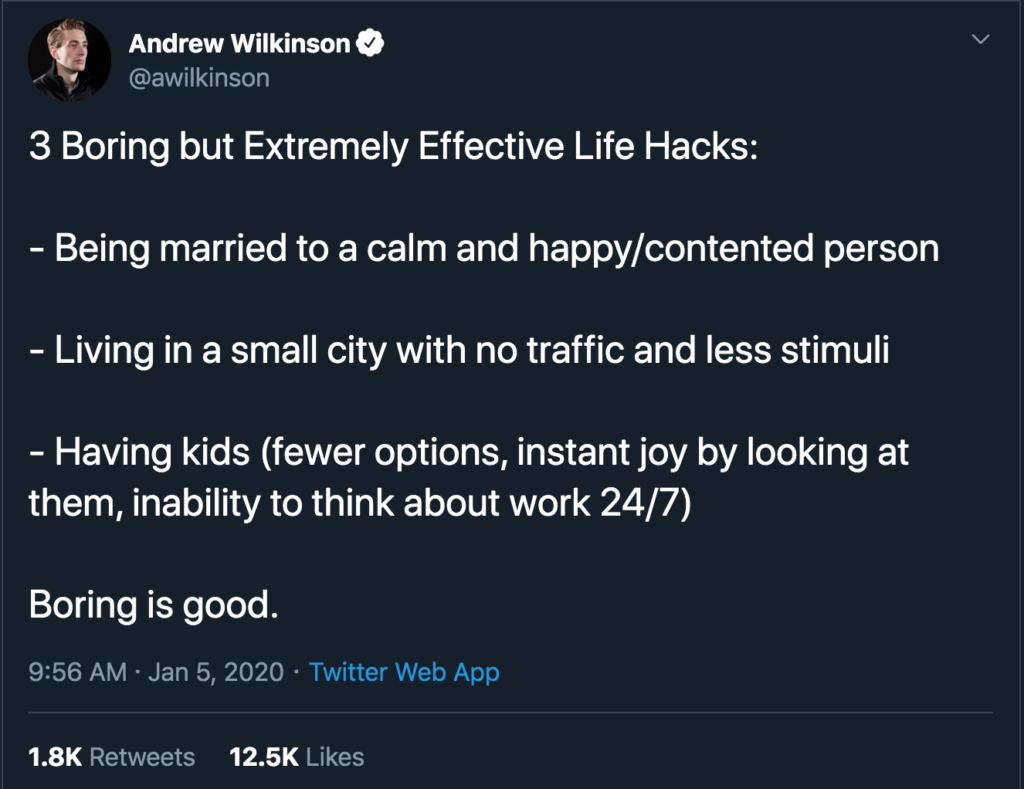
Why do I do what I do? I could quote Ozymandias or the story about the Businessman and the Fisherman. Instead, here’s this tweet from Andrew Wilkinson.

What a stark difference from self indulgent “How to be Successful” twitter nonsense threads from SV luminaries yet, still, too prescriptive and infused with unacknowledged privilege. It’s not that he’s wrong; it’s the distinct “welcome to everyone else’s life” vibe, the discovery of the joy of fishing once you’ve built the business rather than just enjoying fishing in the first place, that I both strongly identify with and feel is, at the same time, incredibly ridiculous.

I don’t have any aspirations to tell others what to do. The past decade has been insanely good to me, through a combination of luck and hard work. Coming into this decade, and starting the fifth decade of my life, I’d like to remember that the Big Things we think matter, really don’t that much. That I matter a lot to a few people and I don’t matter all that much to most people, and that’s just how life is. That after satisfying my basic needs it’s more important to think whether I should do something rather than whether I can. I will continue making mistakes, but maybe less. I hope to enjoy the journey more. Most of all, I hope to not take myself too seriously.

CEO dinners

A few years ago one of my HR people suggested that I start having small CEO dinners with teams as a way to get to know people, talk about the company, and create another forum to exchange ideas. I liked the idea immediately. Earlier this year I also ran across this story about Greg Popovich and how he uses dinners for team building. It all made sense: eating is a communal activity and connecting around a shared meal is human nature (though we go to a reasonably priced tapas place in SF, not a Michelin-starred restaurant).

Since I’m not much of a smalltalk aficionado I had to find a structure that worked for me, and I settled on personal histories. Each participant (these are usually very small events of up to 6 people including me) spends some time talking about their personal history, in as much detail as they would like, and answer questions from others if they’re open to them. I’ve listened to some incredible life stories and perspectives this way and even more than they helped my team connect with me, CEO dinners helped me connect with my team beyond the 150 person point, one that have I never crossed before as CEO.

I found that most people have a really hard time talking about themselves, even if they desperately want to share. I also found the people’s stories change as they attend more dinners, either because they highlight different aspects of who they are, or because they’re more comfortable sharing. I’ve had to learn to ask questions in a non-intrusive and empathetic, genuinely curious way, to get people to open up. It helps that I really like these people but it didn’t happen by itself. Naturally I also put my foot in my mouth several times with ill-timed questions. It’s a process.

Having small-forum CEO dinners that people choose to attend, and learning how to ask people questions became an important way for me to connect with my team, especially as it is growing. I recommend you try it. Just don’t take my usual table at [restaurant name redacted].

Founders, VC funding won’t save you

A few weeks ago I made a silly Twitter joke about starting a fund that invests $300 to make you a unicorn. 99.99% of the readers got it. A couple dozen people who showed up in my DMs and pitched me seriously did not. At some point I even asked what they’d do with $300 and one guy said “maybe buy a ticket to an investor meeting”.

This isn’t good. Not only because it reeks of desperation, but because it signifies a fundamental misunderstanding of venture capital funding and how to use it. I see two reasons for this misunderstanding: founders internalizing the constructed narrative around VC funding as the panacea for tech startups, and VC partners’ branding as enlightened king makers. Both are wrong.

Not enough people talk about VC funding being a tool in a tool box, and those who do often talk their niche position rather than make a general argument on how companies can grow. Companies flush with cash also tend to make a lot of noise (then mostly die with a whimper) on “tech blogs”, the startup world’s Instagram. In addition, many founders have been mostly in school, where you study in a constrained system and get graded by someone, so the North Star metric of funds raised seems appealing.

This is insane. It creates crazy situations. I don’t talk to many early stage founders and I’ve already come across people who are trying to raise millions to fund products that 1000 users could pay for. A two-digit team with only one developer and no one else even learning to code. A team of “business founders” unable to recruit a single developer, raising money to employ contractors. If this sounds like your company, stop raising right now. You’re already failing, and if by miracle you manage to raise funding you’ll just fail slower.

The other issue is the VC narrative. Most VC partners are smart and talented people who mean well and try to do right by everyone. They are also virtually indistinguishable; much like buyout firms correctly think every technology company tastes like chicken (Robert Smith WSJ story here), most VC funds are commoditized agents, pulling money from common resources and deploying it into an undifferentiated deal flow. As commoditized agents do, they invest a lot of time in branding, focusing on outsized successes (infrequent) and conveniently tucking away failures (the norm). Founders fall in that trap like many others do, and hope to be the next anointed genius, talking about “investors who can help us” with starry eyed devotion. It doesn’t last. VCs usually can’t really help you. It is not the VC’s fault and they’re not the bad people here. It’s just reality.

If you’re starting a company, especially if doing so for the first time, you owe it to yourself to understand all the tools available to you. You have to think clearly what success means, and plan accordingly. See yourself, investors, customers and other players for what they are – imperfect players playing a game. Don’t lose yourself in it.

What’s a Chief of Staff

I have a chief of staff at TrueAccord as of 2019 and I had one at Klarna. I see people hiring for chief of staff who don’t really have any staff, which is interesting. I think CoS became a fancy term for an executive/personal assistant or a stand in for ops manager, and that’s unfortunate especially for people who take this mislabeled role and then try to get hired as a CoS under someone who knows what to expect.

So by elimination, what a CoS is not: they are not in charge of the exec’s calendar, other than for meetings that really manage staff (e.g. staff weekly operating meeting, KPI dashboard, monthly and quarterly planning, etc.) They shouldn’t be doing your expenses or getting lunch when you’re in back to back meetings. There’s a place for an assistant but a CoS isn’t it. A CoS isn’t an operating executive either. You hire an executive to do a job you’re currently doing, only better than you. They are often a subject matter expert (even if that expertise is people or general management) and they take on operational responsibilities and manage to goals through others. While in a big enough company the CoS may manage the office of the executive (including the assistant, for example), they are not operating independently of the executive.

A chief of staff is an extension of the executive. They often have some overlap in interest, capabilities, and responsibility areas with them. Other than operating cadence for the exec’s staff, they mostly work on ephemeral projects aimed at progressing the exec’s tactical interests: solve a tactical issue, pressure the organization to progress on a specific task, and so on. While they represent the exec they are not them, so they can act with similar authority but not be as intimidating which is helpful when putting the pressure on lower levels of the organization. At TrueAccord, my CoS facilitates weekly leadership meetings, supports budgeting and board meeting prep, and then works on a variety of tactical projects, spending time with analytics, client success, accounting, or sales as needed. There is a lot to be gained from hiring the right person to be your CoS to do the right type of work. It’s a waste to do so to make yourself feel important.

About finding your place

It happens that a man is born into a foreign land.

It happens that although he has a father and a mother, brothers and sisters, a language and culture – he is actually from someplace else, and he doesn’t know that he is. He agonizes his whole life, until he realizes it, and starts his journey back to his homeland, one he never visited and no one can guarantee even exists.

This man is born into hell, and initially he doesn’t know that it is hell that he was born into.

He goes on to live his life, stumbling over and over, and only after a long while something happens: a moment of grace, when he gets to see – if only for a fleeting moment – his own place in the world. A torn postcard from his place, let’s say. Or someone who’s from there that passes by and smiles – a moment that changes his life, because he suddenly realizes that that place exists. That he isn’t dreaming. That there is a better life than the one he’s living now. And, of course, at the same moment he realizes that he’s living in hell.

(Uzi Weil, originally in Hebrew. The bad translation is mine.)

***

I was standing in the middle of the dance floor, suited up. The speakers were blaring pop music from the stage above the DJ, where one of the country’s most popular singers gave a full performance. I was surrounded by tall, beautiful, extremely trendy people drinking cocktails and yelling over the music, or taking a photo of the singer on their phones.

This launch of a new European investment fund was wrong on so many levels.

***

I fell in love with Silicon Valley on my first visit. It wasn’t nature or the weather. It was the people. So charmingly approachable, and enthusiastic, and authentically interested in technology. So awkward and obviously using well rehearsed communication protocols that they reverse engineered. It was geekdom. I was hooked.

It took me two and a half years to get my Green Card. When it was time to prove my vaccination history for the application process I just re-took all of them, because it was much shorter. My corporate-appointed immigration lawyer asked me to stop pushing her to handle the process faster. I was obsessed. I was going to be a part of the action. Silicon Valley was my place.  

***

Every attempt I’ve seen to replicate the Valley misses by a long shot. It happens when you focus on appearance instead of essence, and forget history. It’s easy to focus on Elon Musk, the guy with the perfect hair who was dating that actress or singer. Who cares. Elon Musk who started PayPal was a geeky, balding guy who teamed up with a crazy hedge fund manager who wanted to overthrow the government with a new currency, and fought him tooth and nail until they both became rich. Microsoft is this software behemoth and Bill Gates is a billionaire but he’s also the world’s worst dad dancer who forgot to eat if he got into an argument, and destroyed his opponents without making eye contact.

Try to observe what makes this place tick. Listen. Don’t fixate on the end condition. Don’t fixate on the glamour and survivorship bias. Silicon Valley is what it is because geeks built it and geeks maintain it. That’s the one thing those other ecosystems get wrong. They have lunch meetings and take five-week vacations. They won’t help unless you give them equity. They promote within their well-defined cliques. They try to get a project funded with a part time CEO and a 20% “chairman of the board”. They invite models and pop stars to launch parties and think the deal flow will just reveal itself. That’s missing the point.

***

Popular culture looks at the Valley’s successes and misgivings and weaves a narrative. Sure, it’s over funded, and over hyped, and over the top in many ways. It has a ton of problems. It’s starting to crack under the hype and abusive behavior by people who don’t get it. Silicon Valley is counter culture, even if what it counters varies and changes. It always tries to oppose, and sometimes forgets to lead. It is also a source of aspiration and inspiration to everyone in tech. It sets a tone.