Category Archives: Uncategorized

Solving problems when growing is more complex. Here are some ideas.

As organizations grow they start to trade agility for scale and repeatable process. It’s mostly a healthy trade off but there are many instances in the early hyper-growth stage where the standard operating procedures they teach you in B School fail miserably. Executives can reverse the trend but they have to be both attuned to those failures as they happen and willing to make fast and tough decisions. Both of these behaviors can be perceived as impatience and not letting things “play out”. I’ve yet to see a bad situation solved with just patience, though. The ability to make tough decisions and cut through red tape is what separates greats executives from good ones.

There are three tools I’ve seen work, from the mildest to most extreme.

Resetting KPIs helps since what gets measured gets improved. Many times merely asking for a number (e.g. SLA) to be presented transparently will drive some change. Then, you have to reset priorities (can’t do everything at the same time) and get a time commitment to hit a goal (i.e. I will reach 90% SLA within two weeks). Change will still take some time because large teams work on building momentum, so this isn’t a good tool for a new type of problem, a systematic problem, or one that needs immediate change (not all problems do).

Hiring and reorganizing is more extreme but should be used more often in mid stage organizations. When transitioning from early to growth stage it’s often easy to forget that you have more managers, a better organizational backbone, and the budget to solve some problems with hiring. So instead of doing the above, executives add more responsibilities to an existing team. It used to work early on but when growing fast it’s hard to even maintain your current responsibility and the existing team will likely not give this new area enough attention. Identifying a problem then hiring someone (often more than one) to manage it is often the right solution.

Doing it on your own. As a founder CEO I love getting my hands dirty and it’s often not the right decision. However, as organizations grow they rely more on momentum and complex processes than thinking from first principles. Two years into TrueAccord I once asked the staff why we gave team updates in the order that we did. Not many remembered it was the result of me randomly ordering Trello boards when we started. Random decisions become gospel due to momentum and it’s often up to the executives to tackle a hairy problem, make it their top priority for a short while, create the way to handle it and then hand it off. This way you’re not only solving some of the problem, you’re also setting your team up for success and are more likely to hire an expert to build on your early iteration (while constantly criticizing it. Try to not take it personally).

These tools are effective and mishandling pressing issues can kill your business just as it hits scale. Don’t fret too much about people complaining about misalignment and the definition of success changing. As Tuckman’s model for team dynamic shows us, it takes time for teams to realign around a change in prioritize or structure even in the best of situations. As long as you don’t do it too often the teams will figure out a way to work. Having a problem and not measuring it or setting a goal to solve it is worse. Cut through the noise when you have to.
Staying on the rollercoaster gets easier over time

I was talking to an early stage CEO on the cusp of a pivot and last minute round extension, dovetailing on losing a co-founder. On one hand sounds pretty bad, on the other – it’s a day in the office for most early stage CEOs. By the end of the call he asked me if it gets easier over time. I always lose sleep in the first phase of a new role or company, no matter how experienced I am, but I do think it does get easier, in several ways.

Pre product market fit, every threat could kill your company. It’s absolutely possible your whole idea is worth nothing, that your entry point is invalid, that you spent too much. Post PMF and at scale, while the stakes feel higher, you’re not likely to lose the company (someone told me the other day “>$10m ARR companies don’t die” which rings true). Post growth the only thing to compare to is your day dreams and whatever photoshopped merchandise they’re selling on TechCrunch, where everyone is up and to the right and the sun is always shining. It stops being a material risk and starts being about your own psychology.

Once you reach a certain size, you’re also a bit more isolated from day to day swings. It may feel frustrating for founders who’re used to hands on work but it’s mostly good when someone else, often more qualified than you for a specific job, can handle fires. As you grow you have more, not less, issues to deal with and hiring and scaling well helps deal with them without handling too much of the emotional strain. Last month we had some fire at TrueAccord that was extinguished by a team of people, without my involvement, in just a few days. Three years ago the same issue went undetected for a month then took the whole team at least three non stop weeks to fix. I’d call that progress.

The last and probably most important thing is emotional maturity. With time you become more resilient – because you’re literally maturing with the company, because of additional experience, and because you’re starting to realize fires always happen and they must be taken in context and proportion. Mastery of oneself is important and if you reach said mastery, tell me how. I’m still working on this one.

Why I’m back to blogging

I haven’t blogged here for quite some time before July 2018. Running a company and having a young family preclude spending much time on anything but. However, as TrueAccord scales I find that writing makes more sense for a few reasons.

Writing helps me organize my thoughts. As I noted in the 50% rule I spend more time thinking about strategy, organizational design, and other topics outside of firefighting. Writing helps solidify my thinking and communicate it effectively.

Writing and podcasting are also better distributed than keeping my thoughts to myself or just sharing with my team. Better distribution of ideas increases the chances of finding like-minded people. If some of them choose to take part in TrueAccord’s journey, we all gain.

Finally, the supply of content for growth stage companies, which is the stage I’m currently interested in, is limited to VCs and semi-retired operators. I think we’re missing the perspective of people who are immersed in the day to day of it.

So, short blog posts written whenever I have time, discussing a top of mind topic, hopefully edited for brevity and clarity. Thanks for reading.

Power doesn’t corrupt.

People say that power corrupts and I take issue with the simplification. “Power” (i.e. the ability to influence another’s life, in this instance) in itself doesn’t corrupt, but the realities that come with it sometimes do. Influence distances you from others (this is often worded as “it’s lonely at the top”), the distance creates alienation, and if you’re not careful, it erodes empathy. That’s the danger zone.

We’re sold on the role of the leader or power broker and how amazing it is to be in control. I love being CEO but there are elements of the job that are grating and problematic and must be managed. One of the most problematic elements is people management at scale. Early teams may be bound by personal relationships and a shared sense of mission but scaling cannot (and shouldn’t) create a homogenous team. By your 100th employee you have a decent chance of hiring someone who grows to dislike you, someone who’s a “coaster”, maybe a psychopath. You’ll hire a bunch of people who have different motivations, are in a different spot in their career, or are just different than you. You’ll need to fire people. You’ll face criticism that may feel deeply unfair. You’ll also hire amazing people that will do incredible things but for type-A people who become CEOs it’s the criticism that registers the most.

All in all pretty stressful if you can’t handle it.

Some try to deal by referring to their team as a “family”. That’s deeply wrong because the word “family” implies a level of commitment that doesn’t exist in companies. You don’t fire a family member and they don’t leave you. You don’t negotiate base pay with your uncle. Thinking of your team as a family creates unreasonable expectations that are bound to disappoint.

The more common way is to be jaded, feel betrayed, decide that employees “just don’t get it.” That’s the alienation that leads to eroded empathy. Thinking of people like chess pieces. It’s arguably a natural response based on research telling us that our frame of human reference can hardly encompass more than 50 people, but it’s also the wrong sentiment and must be resisted vigorously.

We have to hold on to empathy. You can partly manage this issue by thinking of your public self as a separate persona (I sometimes do) but at the end of the day you must accept that having influence over others opens you up to be influenced by them. It’s a two way street. My old martial arts Sensei used to say that people think of strength as not being dependent on anyone, but “We weaken ourselves by accepting our dependency on others and their dependency on us. That is true power.” I like this sentiment. Holding on to empathy is crucial. It’s also easier when you take care of yourself and have a support network that keeps you grounded.

The 50% rule

Talking to first time CEOs and executives in high growth companies, the thing that overwhelms them the most is the nagging feeling that they have to actively operate the business or everything falls apart. This often leads to exhaustion, mental first and then physical, which in turn hurts their ability to do their actual job.

Like most other things, I had to learn this the hard way and was forced to hire lieutenants during my first stint as a senior manager. Steve Jobs was once quoted that about 50% of his time is unstructured (can’t find the quote now). I think that’s roughly true. Spending time away from tactical responsibilities allows you to:

  1. Think strategically. One CEO told me how the first time he took a vacation after 4 years in the trenches led to deeper thinking and an acquisition by a public company. Worrying about tactical issues drains that capacity for strategic thought.
  2. Fix major issues. As a senior exec you’re going to get involved to steady the ship, right a wrong, save a major relationship. This is especially common in enterprise startups where you’re often fodder for the client’s senior execs to chew on to protect your team. This is both stressful and humbling and cannot be done if you’re exhausted.
  3. Convince. Once you reach a certain size it’s not about just fight or flight anymore. You have a large team of opinionated people and you need to inspire, convince, and direct them instead of practicing battlefield command and control.

The amount of time I spend thinking, talking, and writing about the business rather than creating anything will surprise anyone and stands in complete contrast to the “creator” myth that startupland loves so much. As a growth CEO it’s my job to become an ideas merchant, not a builder. Staying at the right level of abstraction and leaving a lot of unstructured time is critical.

Why work for a Series B startup

Between large companies paying insane salaries to the cost of starting a company plummeting in the past decade, why work for a Series B company? They’re often messy, equity’s not as good as an early stage company, career ladder not as well defined as a largeco.

Series B companies are spring boards. If you are a top performer frustrated by corporate politics or a rigid career ladder, you’ll get much more responsibility faster in a series B company. Unlike in early stage startups, it will be better defined for a specific practice, so you can be a lawyer or client success manager and get promoted quickly rather than have to be “person who fixes production issues at 2am”.

Series B companies offer more visibility. At this stage organic growth usually isn’t enough so if you’re articulate or a good writer you could find yourself speaking publicly more often than you would otherwise.

Companies at this stage are also on the cusp of meaningful specialization. You can get an opportunity to own your niche area, define and grow it, be it UX or content marketing or software architecture.

I used to be part of the cult of entrepreneurship and thought that everyone should start a company. That’s silly. There are many more opportunities for scale and growth post Series A or B. While you “pay” for the reduced risk with a smaller equity windfall, most early stage startups fail anyway. If you’re an up and coming professional looking to grow fast, growth stage is the perfect time to join a startup.

Motivation

Many words spilled this week about founders’ motivation to start companies, mostly by people who aren’t founders.

I start companies because I want to control my destiny. The corporate world is as insane as feudal Europe sometimes, and some of us don’t want to be someone’s court jester or kiss a brass ring. I don’t know if it’s a noble motivation but I do know that I’d rather achieve that level of independence alongside team members I appreciate and who enjoy that same sensation (co-founders and employees) and that if you’re lucky, like I am with TrueAccord, it aligns with a business that actually makes a social difference and will be huge.

Given the above, it’s clear that exit calculations at Seed or D make little sense because an exit is never the goal. I don’t think of companies as solely a mechanism for transfer of wealth. Naturally, it’s easier for me to write this after I’ve had an exit.

It’s also clear that the title “serial entrepreneur” is as silly as “serially failing to achieve independence”. You don’t get married hoping to get divorced in two years, or at least I hope you don’t. You get married for the happily ever after.

Company founding also isn’t, for me, about being right once and going the angel investor to VC route. My company isn’t a pet project to show that I can qualify for the next level in the distributed corporate world that a part of Silicon Valley has become.

There’s nothing wrong with the above approaches. They’re just not my thing. I respect other people and their choices and frankly, many of them are smarter than starting and scaling a company because they are less painful. I’m the one who’ll be chugging away ten years from now, running a three thousands person company worth a significant amount, fighting unhealthy routines and putting out ever larger fires and whatever else you need to do at that scale (hopefully not playing golf. I dislike golf). That’s just my thing.

4th of July

A note I sent to the TrueAccord team today:

Happy 4th of July, everyone.

If you’ll allow me my soapbox moment: for all the doom and gloom and concern many (but not all!) share, for all its complexities and faults, for *me personally* this is still the greatest nation on earth. The land of the free and the home of the brave, whether you’re born to it or adopt it. As a proud immigrant on this day of independence, I hope to celebrate my next independence day as a citizen. I am proud to be fixing this country with you, one underserved consumer at a time. Proud to be together in the modern trenches. Let’s keep on making magic together.

Have a great day!

About leaving

The rolling dunes of the Israeli desert shift all the time. Leave a footprint, and soon enough it disappears. The wind blows fine sand around and covers your tracks, until only the Bedouin rangers can track you down, if at all.

***

When I was twenty-nine years old, my boss at PayPal was let go. They didn’t say why. He was going to spend time with his family, corporate PR said. It wasn’t the truth.

I called my VP. I’m ready to take over the branch office, I said. She was polite, but nothing came of it. No one would say it to your face over there. She didn’t think I was ready. I thought I was. I was wrong, but I didn’t know that.

A few months later, they announced they hired someone. He’s Chief Risk Officer at PayPal now. On his first day, when I met him, I said – it’s not personal, I’m leaving Israel. I’m going to San Jose. Ok, he said, how soon can you leave?

W–what? I’m indispensable! I didn’t say that. I just knew it to be true.

When I left, I thought there would be much fanfare. I had just turned thirty. I told the story of how I started five years earlier. I choked up a bit. People were very nice. They clapped when I finished my talk. There were pretzels.

Within two months, the team reorganized without me. I left footprints, slowly covered by the sands of time. A sentence in a job description. A procedure file. Several hires. Eventually even the Bedouin couldn’t find me. I was gone.

Confused, I called my mentor, Davidi. I don’t understand this thing, I said. How come I vanished this way, so fast? It was five years of my life.

Davidi sighed. When are you going to take your head out of your ass and understand that it’s not about you? He was fifty-five years old and slowly dying of cancer. Gentle delivery wasn’t a priority.

I didn’t get it then.

***

In 2011 I was thirty-one years old. I was Chief Risk Officer at Klarna and had just parted ways with a senior manager from my team. I had to, for various reasons. I didn’t say he was going to spend more time with his family. He went to start a risk management team at another company, and within a short while he poached M.

I didn’t think much of M, I told the COO. It was the truth. Losing him was okay. I’ll be worried if he hired F.

The following week, F gave his notice.

The CEO came to my apartment. He was upset. He was on the phone with the COO, his co-founder. Niklas says you said you couldn’t afford to lose F, he said. I didn’t have an answer. That night was the first time I lost sleep. It wasn’t the last.

Within two months, the team reorganized without them. Some signs lingered. Lines of code. A document or two. A couple of hires. But people rose to the challenge. Some I promoted, some hired. Eventually all of the old team’s footprints were gone, covered by the sands of time. The organization got over them. 

***

I didn’t get it then but I get it now. People are important, but communities are stronger than the individuals that comprise them. Strong companies with strong momentum are especially resilient.

It’s not about you. It’s not about me. It’s about this construct we build and maintain, a company. It’s bigger than just us. It has a life of its own. You leave when your story ends, hopefully not too soon, and you leave a footprint, but the company lingers. It is stronger than any individual. People will rise to the challenge; they will grow into new roles. Some stories will diverge from ours and some will join in. And that’s how it’s supposed to be.

With great power comes… a great misunderstanding

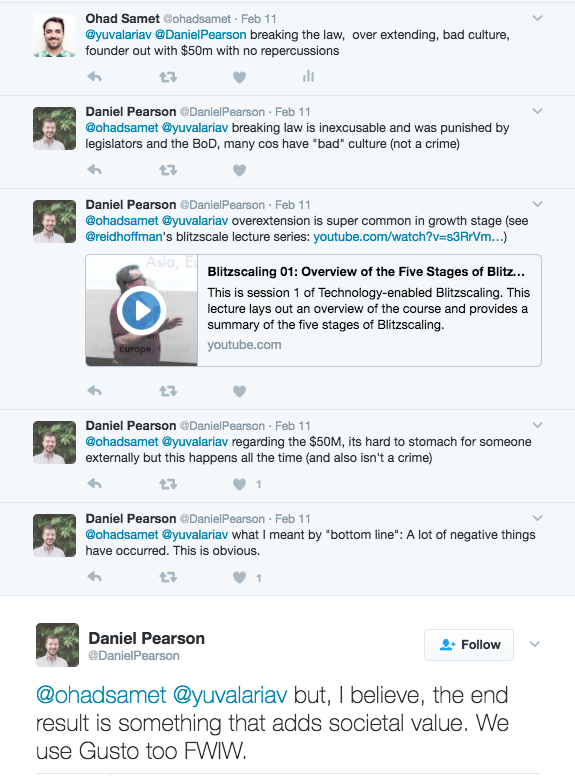
I don’t have the time to write an assay about the topic, but the growing disconnection between legality and morality in Silicon Valley is alarming. I’m going to just put this thing here so I’m on the record.

(Disclaimer: I don’t know Daniel Pearson and he may be the best guy on earth. I’m simply referring to the opinion he expresses here)

Screen Shot 2017-02-12 at 12.44.55 PM

Companies like Zenefits are a problem not only because they broke the law. That’s meaningful, but is not the only issue. They are meaningful because they enshrined abuse of power and misrepresentations as a way of doing business. They mixed inexperienced employees with power hungry inexperienced executives in a business that was growing too fast for its own good.

Zenefits is not alone, they are just the tip of the iceberg and they got caught because they also broke the law. The abuse of power is the much bigger issue. One, because it is prevalent. Two, because it is not often discussed. Three, because it is the result of people conflating financial success with moral superiority. The latter isn’t a new idea and was introduced by Max Weber in the start of the 20th century. The latest turn is using financial success to justify immoral behavior, and flaunting social norms because they aren’t the law. Yes, including with the elected President.

What’s abuse of power? It’s cashing out from your anonymous-abuse-enabling app that is only growing thanks to the abuse before it crashes and burns. It’s creating an excessive drinking culture in the workplace that may pressure inexperienced employees into acts they may not be interested in. It’s self dealing in office. It’s hiring managers who focus on rating employees by their looks. It’s founders buying back stock from employees at a discount because they know a valuation-popping event is coming up. All of these may not be illegal or provable in court. They’re still wrong. The fact that people (let’s face it – men) in SV express that they matter less because someone is rich or created business value is preposterous. Dollars are not the only way to measure value; they’re not even the most important way. We just lost our compass, as a subculture, because we got flush with too much money. It’s a sad realization.